
Braces vs. Invisalign: Which One Is Right for You?
By Dr. Pia Lieb
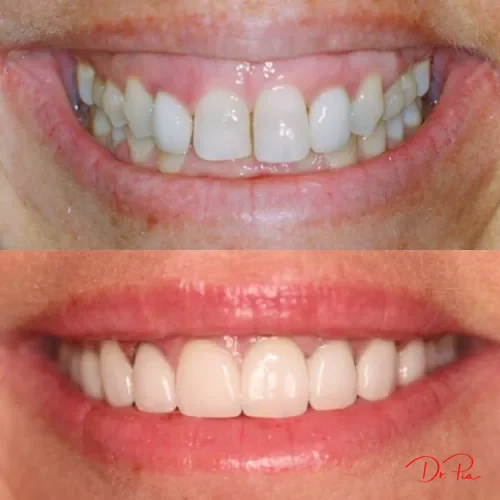
Both traditional braces and Invisalign-style clear aligners straighten teeth effectively: the right choice comes down to how complex your case is, how visible you're willing to be, and how disciplined you'll be about wear time. Braces handle the toughest cases; aligners win on discretion and convenience.
How do traditional braces work?
Traditional braces use metal brackets and wires bonded to your teeth, adjusted periodically to move them into place. Because they are fixed and always working, they deliver steady, precise force that can correct almost any orthodontic problem.
Strengths:
- Power and precision: handle complex crowding, rotations, and significant bite problems
- Work without relying on patient compliance (they are always on)
- Often the most cost-effective route for complex cases
Trade-offs:
- Visible metal on the teeth
- Food restrictions, no hard or sticky foods
- Brushing and flossing take extra care around the hardware
- Wires and brackets can occasionally irritate the cheeks
How do clear aligners like Invisalign work?
Clear aligners are a series of custom, near-invisible trays you swap every one to two weeks, each nudging your teeth a little closer to their final position. You remove them to eat and clean your teeth, then put them back.
Strengths:
- Nearly invisible: popular with adults and image-conscious teens
- Removable: eat, brush, and floss normally
- More comfortable for most patients, with no brackets to rub
- No food restrictions
Trade-offs:
- Require 20 to 22 hours of wear daily: they only work if you keep them in
- Not appropriate for the most complex tooth movements
- Easy to lose or damage if not stored properly
Explore our Invisalign service for more, and see how in-office treatment compares with mail-order options in our guide to at-home vs. in-office clear aligners.
How much do braces and Invisalign cost, and how long do they take?
Braces typically run 12 to 24+ months; Invisalign often finishes in 6 to 18+ months for suitable cases. Costs overlap heavily, and the gap has narrowed as aligners have become mainstream. Your exact figure depends on case complexity and treatment length.
Swipe to see more →
| Factor | Braces | Invisalign |
|---|---|---|
| Treatment time | 12 to 24+ months | 6 to 18+ months |
| Visible | Yes | No |
| Removable | No | Yes |
| Best for | Complex cases, kids/teens | Adults, mild to moderate cases |
Which should you choose?
Choose the tool that fits your case complexity, discipline, and priorities. Braces suit complex corrections and patients who won't reliably wear a removable tray; aligners suit milder cases where discretion and convenience matter most.
"My personal opinion is that I find fine-tuning much easier with Invisalign than with braces. As an artist, every millimeter counts, and Invisalign gives me the control I need to achieve precise results."
Dr. Pia Lieb
Choose braces if:
- Your case is complex or involves significant bite correction
- You know you won't reliably keep aligners in
- Cost is a primary concern
- You're a child or teen with developing teeth
Choose clear aligners if:
- Your case is mild to moderate
- You value discretion
- You're disciplined about wear time
- You travel often or have appearance concerns
Is there a middle path for mild cases?
Yes, for mild cases, some patients align the teeth first, then add small cosmetic touches instead of hardware. After a short course of aligners, minor imperfections can be finished with conservative cosmetic work rather than lengthy orthodontics.
That might mean whitening to brighten the result, no irreversible restorations required. For the fuller comparison, read our take on orthodontics vs. cosmetic cover-ups.
Why does retention matter after either treatment?
Teeth naturally drift, so both braces and aligners require a retainer afterward to hold the result. Skipping retention is the most common reason a straightened smile relapses over the years. Your orthodontist will set a wear schedule, often full-time at first and then nightly long term.
Frequently asked questions
Are clear aligners as effective as braces?
For mild to moderate cases, yes. For complex bite or rotation problems, braces often remain the better tool.
How long does Invisalign take?
Most suitable cases finish in 6 to 18 months, depending on how much the teeth need to move.
Is Invisalign more expensive than braces?
Often slightly, but the cost gap has narrowed considerably as clear aligners have become mainstream.
Can I switch from braces to Invisalign mid-treatment?
Sometimes. If you are considering it, discuss the timing and cost with your orthodontist before making the change.
The bottom line
If your case is straightforward and you value discretion, aligners are appealing. If your case is complex, or you know you won't reliably keep trays in, braces will likely get you a better result. A consultation is the fastest way to know which fits your bite and your lifestyle.
This article is for educational purposes only and is not a substitute for professional dental advice.
with Dr. Pia to compare both options for your smile.