
Inlays and Onlays: Between a Filling and a Crown
By Dr. Pia Lieb
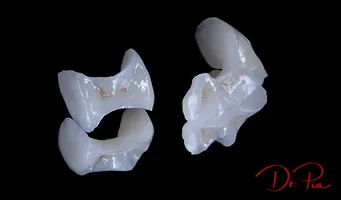
Inlays and onlays are custom-made restorations that sit between a filling and a crown, repairing a damaged tooth while preserving far more of its natural structure than a crown removes. If a tooth needs significant repair but a full crown feels like overkill, these restorations from our cosmetic dentistry services are the middle path worth understanding.
What are inlays and onlays?
Inlays and onlays are solid, custom-fitted restorations, usually made of tooth-colored porcelain or composite, that are crafted outside the mouth and then bonded onto a damaged tooth. They are sometimes called "indirect fillings" because, unlike a standard filling shaped directly in the tooth, they are fabricated first and then fitted precisely.
The difference between the two is how much of the tooth they cover:
- Inlay: fits within the grooves of the tooth, between the raised cusps
- Onlay: extends further to cover one or more cusps (the raised points of the chewing surface)
Both are made in a dental lab or milled chairside, then cemented in place for a snug, sealed fit.
When do you need an inlay or onlay?
You need an inlay or onlay when a tooth has too much damage for a standard filling but still has enough healthy structure that a full crown would be too aggressive. It is the ideal choice for medium-sized damage on a back tooth that does most of the chewing work.
A dentist typically recommends one when:
- A tooth has too much decay or damage for a reliable direct filling
- Enough healthy tooth structure remains that a full crown would be unnecessary
- An old, failing metal filling needs a more cosmetic replacement
- A cracked or moderately decayed back tooth needs added strength
That is the sweet spot: stronger and more durable than a large filling, more conservative than a crown. If you are unsure where your tooth falls, see when you actually need a dental crown.
What are the advantages of inlays and onlays?
The main advantages of inlays and onlays are a natural appearance, high durability, and the preservation of more natural tooth than a crown. Because they are bonded solid restorations, a well-placed onlay can actually reinforce a weakened tooth rather than just plug a hole.
- Natural appearance: porcelain or composite is matched to your tooth color
- High durability: they typically outlast large direct fillings
- Conservative: they preserve more natural tooth structure than a crown
- Cosmetic upgrade: a clean replacement for old, dark metal fillings
- Strengthening: a precisely bonded onlay supports a cracked or weakened tooth
What are the trade-offs of inlays and onlays?
The trade-offs are a higher cost than a standard filling and, in many cases, two appointments instead of one. For the added durability and conservative approach, most patients find the trade worthwhile, and same-day options are increasingly available.
- They cost more than a basic composite filling
- They may require two visits: one to prepare and take an impression, one to bond
- Same-day placement is possible where the office has in-house digital scanning and milling
How do inlays and onlays compare to fillings and crowns?
Inlays and onlays preserve more tooth than a crown and last longer than a large filling, placing them squarely in the middle on strength, cost, and durability. The table below shows where each option lands.
Swipe to see more →
| Factor | Filling | Inlay/Onlay | Crown |
|---|---|---|---|
| Tooth structure preserved | Most | Substantial | Least |
| Strength | Lower | High | Highest |
| Appearance | Good | Excellent | Excellent |
| Number of visits | 1 | 1 to 2 | 1 to 2 |
| Relative cost | Lowest | Middle | Highest |
| Typical service life | Shortest | Longer | Longer |
Explore our inlays and onlays service to see how the restoration is planned for your tooth.
Frequently asked questions
Are inlays and onlays covered by insurance?
Often yes, because they are considered restorative rather than purely cosmetic. Confirm the specifics with your insurance provider.
How long do inlays and onlays last?
Service life follows the material and the tooth it restores rather than a set number of years. An inlay or onlay typically outlasts a large direct filling.
Are inlays and onlays noticeable?
No. Tooth-colored porcelain or composite blends with your natural teeth and is essentially invisible in normal conversation.
Are they done same-day or over two visits?
Both are available depending on the office's technology. Same-day placement uses digital scanning and chairside milling; the traditional route uses a lab and two visits.
Inlays and onlays are the "just right" option for medium-sized damage: tooth-colored, durable, and conservative. If you are weighing a large filling against a crown, ask your dentist whether an inlay or onlay is the better middle path for your tooth.
This article is for educational purposes only and is not a substitute for professional dental advice.