
Why to Whiten Your Teeth Before Getting Veneers
By Dr. Pia Lieb
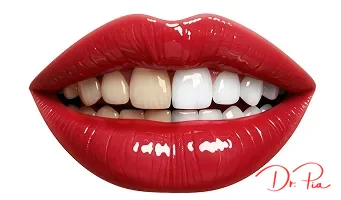
Whiten your natural teeth before getting veneers or crowns, never after. Restorations are made in a fixed color that whitening gel cannot change, so if you brighten your natural teeth later, your veneers stay put and the shades no longer match. The order of treatment is a detail that quietly decides whether your smile looks seamless.
Why can't veneers and crowns be whitened later?
Veneers and crowns do not respond to whitening. They are made of porcelain or composite resin set to a fixed shade when they're fabricated, and that color is fixed for the life of the restoration.
Whitening gel works only on natural tooth enamel. The peroxide reacts with stains inside enamel and dentin; it has no effect on ceramic or cured resin. Once a veneer or crown is bonded in place, its shade is locked in for good.
What happens if you whiten after veneers?
You end up with a visible mismatch. As the natural teeth brighten, the restorations stay their original shade and suddenly look darker than everything around them.
Picture the sequence:
- You get a few veneers matched to your current tooth shade.
- A year later, you whiten your natural teeth.
- Your real teeth get noticeably brighter.
- The veneers stay exactly as they were.
- Now the restorations look dark against lighter neighbors.
The only fix at that point is replacing the veneers to match the new shade, which is expensive, wasteful, and entirely avoidable.
What is the right order to whiten and get veneers?
Whiten first, let the color settle, then match the restorations to your brighter smile. This is the sequence that lets the shade be matched at the time the restorations are made.
- Whiten your natural teeth to your target shade
- Wait about two weeks for the color to stabilize, since the shade can rebound slightly at first
- Have your veneers or crowns fabricated to the new, brighter shade
Because there is a stabilization window, this only works when whitening comes first. Dentin naturally darkens with age, which is another reason to set your baseline before any irreversible work.
Does this apply to partial smile makeovers?
Yes, and it matters even more when only some teeth are being restored. If you're placing veneers or crowns on a few front teeth while leaving others natural, the two must agree on color.
- Whiten the natural teeth first to the shade you want long term
- Then color-match the restorations to that final, brighter smile
That way the restored and natural teeth sit at the same brightness instead of drawing attention to the difference. Veneers are a long-term commitment, so it's worth confirming they don't harm the underlying teeth and planning the shade carefully before placement.
What does the treatment timeline look like?
The full sequence usually spans four to six weeks, most of it spent whitening and letting the shade stabilize before restorations are designed. Plan the calendar backward from any event you're preparing for.
Swipe to see more →
| Week | Step |
|---|---|
| 0 | Consultation and treatment plan |
| 1 to 2 | Professional whitening |
| 3 to 4 | Shade stabilizes |
| 4+ | Restorations designed and placed to the new shade |
How do you keep the match consistent?
Tell your dentist your whitening plans up front and maintain your natural teeth afterward. The match holds only if your natural enamel stays at the shade the restorations were built to.
- Share your whitening plans early so the whole sequence is timed correctly
- Maintain your natural teeth's brightness with touch-ups; our guide to teeth whitening that actually works covers the options
- Avoid heavily staining drinks during the shade-stabilization window
At Cosmetic Dentistry NYC on Park Avenue, Dr. Pia Lieb sequences laser teeth whitening and porcelain veneers together so the shades are matched from the very first placement.
Frequently asked questions
How long should I wait between whitening and getting veneers?
At least two weeks, so the whitening shade fully stabilizes before the restorations are matched.
Can I whiten my teeth around existing veneers?
You can lighten the natural teeth around them, but the veneers won't change, and the result may be a visible mismatch.
Do veneers ever stain?
Porcelain resists staining very well; composite stains more readily. Either way, whitening won't fix a stained restoration, it has to be replaced.
What if I already have veneers but want a brighter smile?
You can whiten any remaining natural teeth, but the veneers stay the same. The realistic options are replacing the veneers or accepting a mismatch.
What's the takeaway on sequencing?
Whiten first, restore second. Getting the order right is the difference between a seamless smile and an avoidable mismatch you'll look at every day. Decide on your target shade before any irreversible work begins.
This article is for educational purposes only and is not a substitute for professional dental advice.